You’ve been running roads for months — maybe years — and every time you pass a muddy footpath or spot a trail disappearing into trees, something in you wants to follow it. Trail running is a different sport to road running in ways that matter, and the switch isn’t as simple as taking your usual route off-road. The terrain changes how your body works, the kit you need is different, and the mindset shift from pace-watching to obstacle-reading takes real adjustment. The NHS recommends running as one of the best forms of exercise, and moving that running onto trails adds variety, strengthens muscles you didn’t know you had, and makes the whole thing more interesting. Here’s how to make the transition without injury, frustration, or ruined ankles.
In This Article
- Why Trail Running Is Worth the Switch
- The Biggest Differences Between Road and Trail
- Shoes Are the First Thing to Change
- How to Start Your First Trail Runs
- Adjusting Your Running Form
- Building Strength for Trails
- Navigation and Safety
- What to Carry on Trail Runs
- Dealing with British Weather on Trails
- Finding Trails Near You
- Common Mistakes New Trail Runners Make
- When You’re Ready for Your First Trail Race
- Frequently Asked Questions
Why Trail Running Is Worth the Switch
Road running is brilliant for fitness, structure, and measurable progress. But after a while, it can start to feel like the same thing on repeat — same pavement, same junctions, same Strava segments. Trail running changes the equation completely.
Physical Benefits
- Stronger ankles and stabilising muscles — uneven ground forces your feet and ankles to constantly adapt, building strength that road running doesn’t develop
- Lower impact — soft ground absorbs more shock than tarmac, which your knees and joints will appreciate over months and years
- Better balance and proprioception — navigating roots, rocks, and camber improves your body awareness in ways that transfer back to road running
- Full-body workout — hills, scrambles, and varied terrain recruit your core, glutes, and upper body far more than flat road running
Mental Benefits
Running through woodland, along coastal paths, or across open moorland is a completely different headspace to pounding pavements next to traffic. Studies consistently show that exercise in natural environments reduces stress and improves mood more than the same exercise in urban settings. After six months of mixing trails into my training, the road runs feel like the backup option rather than the default.
The Biggest Differences Between Road and Trail
Pace Goes Out the Window
This is the hardest adjustment for road runners. On trails, your pace per kilometre is meaningless. A 5:30/km road runner might average 7:00-8:00/km on trails and still be working harder. Hills, mud, rocks, roots, and route-finding all slow you down. The sooner you stop watching your pace and start running by effort, the sooner you’ll enjoy trails.
Terrain Is Unpredictable
Road surfaces are (mostly) predictable. Trails are not. Within a single kilometre you might encounter:
- Dry packed earth
- Ankle-deep mud
- Loose gravel
- Tree roots crossing the path
- Rocky sections requiring careful foot placement
- Stream crossings
- Steep gradients in both directions
Each surface demands different foot placement, stride length, and attention level. This is what makes trail running engaging — and exhausting.
Elevation Changes Everything
A 10km road run with 50m elevation gain feels manageable. A 10km trail run with 400m elevation gain is a completely different beast. UK trails are rarely flat, and the climbs and descents use muscles and energy systems that road running barely touches. Walking the steep uphills isn’t cheating — it’s smart trail running technique used by ultrarunners and fell runners alike.
Shoes Are the First Thing to Change
You cannot run trails in road shoes. Not safely, anyway. Road shoes have smooth or lightly textured soles designed for grip on tarmac and pavement. On wet grass, mud, or loose rocks, they’re dangerously slippery.
What Makes a Trail Shoe Different
- Aggressive lugs — deep rubber treads that bite into soft ground and provide grip on loose surfaces
- Rock plate — a stiff plate in the midsole that protects your feet from sharp stones and roots
- Toe bumper — reinforced toe cap to protect against stubbing on rocks
- Stiffer midsole — more stability on uneven ground compared to the flexible, cushioned ride of road shoes
- Drainage — some trail shoes drain water quickly after stream crossings rather than holding it like sponges
Budget Expectations
Decent trail running shoes start at about £80-90 for brands like Inov-8 and Salomon, with premium options from Hoka, Brooks, and La Sportiva hitting £130-160. Don’t buy the cheapest option you can find — grip quality varies enormously between budget and mid-range trail shoes. Check out our full running shoe guide for tested recommendations across surfaces.
When to Keep Your Road Shoes
Some trails are actually fine in road shoes — well-maintained, compacted gravel paths like canal towpaths or old railway lines. If the trail is dry, flat, and firm, road shoes with light tread work fine. But the moment conditions get wet, steep, or technical, trail shoes aren’t optional — they’re essential safety equipment.
How to Start Your First Trail Runs
Week 1-2: Walk First
Before running a trail, walk it. Seriously. Walk the route at a comfortable pace and pay attention to the surface, the gradients, and the navigation. You’ll spot the muddy sections, the tricky descents, and the places where the path isn’t obvious. This reconnaissance saves you from nasty surprises at running pace.
Week 3-4: Run/Walk Mix
Run the easy sections, walk the steep uphills and technical descents. There’s no shame in walking — even experienced trail runners walk sections regularly. The key is to keep moving and build familiarity with how your body responds to varied terrain.
Week 5-8: Build Confidence
Gradually increase the running portions and start tackling more technical terrain. Your ankles will be stronger, your foot placement more instinctive, and your confidence on uneven ground much higher than when you started. For a related angle, see our Trail Running Shoes vs Road Running Shoes: Key Differences guide.
The 10% Rule Still Applies
Don’t ramp up trail distance too quickly. The muscle demand is higher than road running, so treat trail mileage as roughly 1.5x road mileage in terms of training load. A 10km trail run with significant elevation is as taxing as a 15km road run.
Adjusting Your Running Form
Shorter Stride
Road runners tend to develop a long, efficient stride. On trails, shorten it. Shorter strides give you more control, faster foot turnover, and quicker reactions to unexpected obstacles. Think quick, light steps rather than long, loping strides.
Eyes Ahead, Not at Your Feet
New trail runners stare at their feet. This is natural but counterproductive. Look 3-5 metres ahead of you — your peripheral vision handles the immediate ground while your conscious attention maps the route ahead. This gives you time to plan foot placement rather than reacting to each obstacle at the last second.
Uphill Technique
- Lean slightly forward from the ankles, not the waist
- Shorten your stride even further
- Push off your toes and forefoot
- Use your arms for drive
- Walk when the gradient exceeds about 15-20% — running isn’t always faster on steep terrain
Downhill Technique
Descents are where most trail injuries happen. The key points:
- Stay under control — speed builds quickly on descents and it’s harder to stop than on roads
- Keep your centre of gravity slightly forward — leaning back causes your feet to shoot out from under you
- Quick, light steps — let your feet barely touch the ground rather than heavy heel striking
- Bend your knees more than usual — they act as shock absorbers
- Arms out slightly for balance — think ski moguls, not sprint posture
Building Strength for Trails
Road running fitness doesn’t automatically translate to trail fitness. These exercises specifically help with trail running demands:
Lower Body
- Single-leg squats — builds the stability muscles around your ankles and knees that trails demand
- Calf raises — stronger calves handle the constant terrain changes on trails
- Step-ups — mimics the climbing action of trail running
- Lateral lunges — strengthens the side-to-side stability that uneven ground requires
Core
- Planks (front and side) — core stability keeps you upright on camber and rough terrain
- Dead bugs — trains your core to stabilise while your limbs move independently
- Russian twists — rotational strength helps with balance on technical terrain
Two sessions per week is enough. You don’t need gym equipment — bodyweight exercises at home work perfectly well for building trail-specific strength.
Navigation and Safety
Planning Your Route
Unlike road running, where you can often navigate by street names and landmarks, trails need proper route planning:
- OS Maps — the gold standard for UK trails. Available as an app (about £24/year) with offline maps
- Komoot — popular route-planning app with community-suggested trails
- AllTrails — good for finding popular routes near you with difficulty ratings
- Harvey Maps — specialist fell and trail maps for mountain areas
Download your route offline before you go. Mobile signal vanishes quickly on UK hills and in valleys.
Tell Someone Your Route
On remote trails, tell someone where you’re going and when you expect to be back. This sounds dramatic for a run, but mobile signal isn’t guaranteed and UK weather changes fast. A simple text with your route and expected return time is enough.
Carry a Phone
Your phone is your emergency device, your map, and your camera. Keep it charged and carry it in a running vest or zip pocket, not in your hand where one slip sends it into a stream.
What to Carry on Trail Runs
Short Trail Runs (Under 90 Minutes)
- Phone
- 500ml water (more in summer)
- Emergency £10 note
- Trail shoes (obviously)
Longer Trail Runs (90 Minutes+)
- Phone with offline maps
- 1-2 litres water (running vest preferred)
- Energy gels or snacks
- Lightweight waterproof jacket — UK weather turns in minutes
- Basic first aid: blister plasters, antiseptic wipe
- Emergency foil blanket (weighs nothing, could save your life)
Winter Trail Running
Add to the above:
- Head torch — winter daylight disappears fast
- Extra thermal layer
- Hat and gloves
- Waterproof trousers if the route is exposed
Dealing with British Weather on Trails
Mud
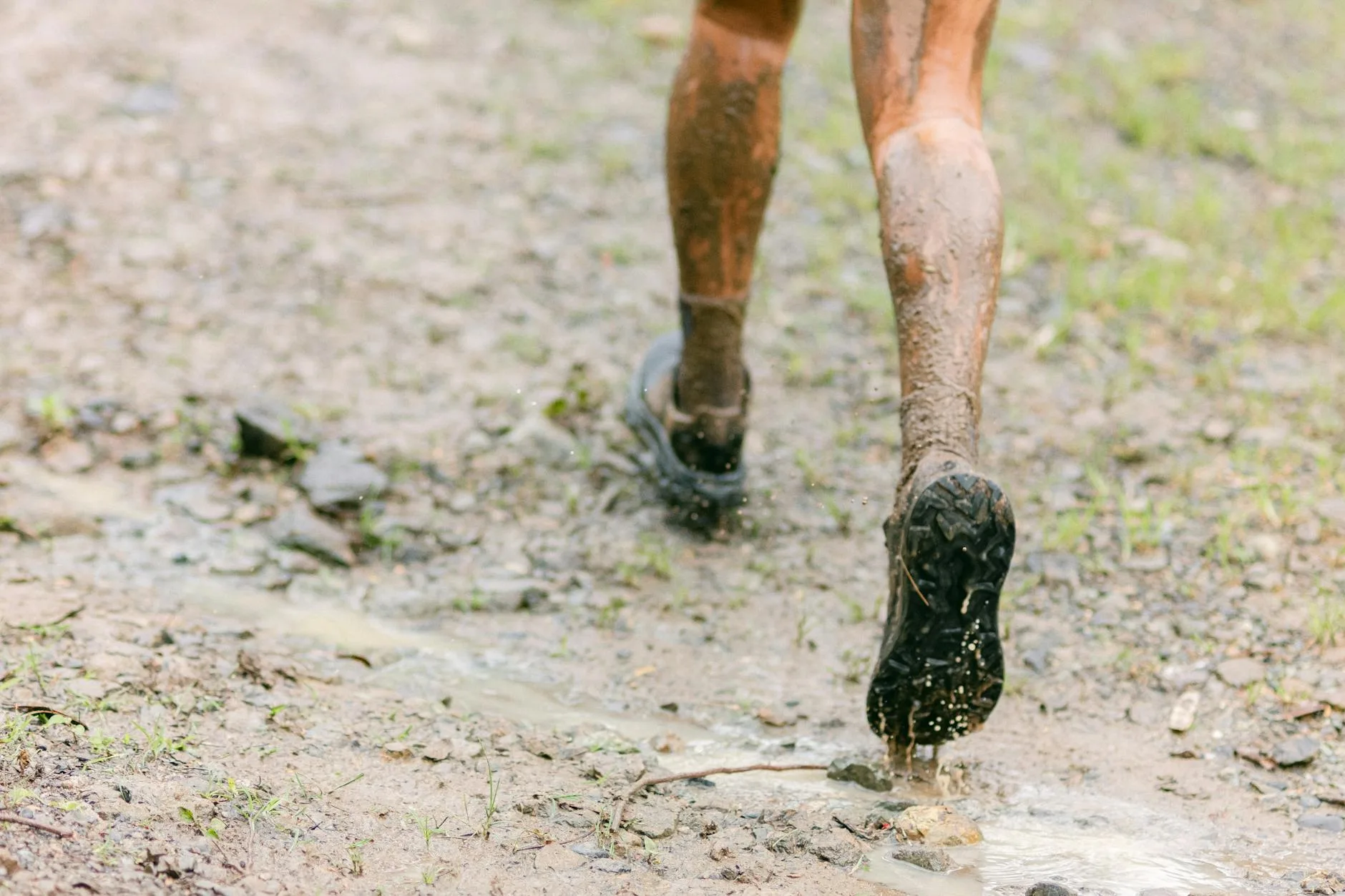
Accept it. Embrace it. UK trails are muddy from October through April, and some trails never fully dry out. Trail shoes with deep lugs handle mud well, but nothing handles axle-deep bog elegantly. If you’re running in the UK, you will get muddy. Dark-coloured running clothing hides it better.
Rain
Light rain barely matters once you’re running. Heavy rain makes trails dangerous — loose ground becomes slippery, streams swell, and visibility drops on exposed terrain. Check the forecast before heading out, and don’t be too proud to cut a run short if conditions deteriorate.
Wind
Exposed ridgeline trails in strong wind are no joke. Wind chill drops the effective temperature sharply, and gusts can knock you off balance on narrow paths. Stick to sheltered, wooded trails in windy conditions. Our Nike vs Asics vs Brooks: Running Shoe Brands Compared guide is useful alongside this.
Heat
Summer trail running in the UK is usually comfortable, but dehydration creeps up faster on trails because the terrain demands more effort. Carry more water than you think you need, and start runs earlier in the morning to avoid the midday heat.
Finding Trails Near You
The Classics
- Lake District — fell running’s spiritual home. Challenging terrain, stunning views, proper mountains
- Peak District — accessible from Manchester, Sheffield, and Derby. Mix of moorland, limestone dales, and gritstone edges
- South Downs Way — rolling chalk downland. Less technical, beautiful, great for trail beginners
- Brecon Beacons — remote, dramatic, and often quieter than the English peaks
- North York Moors — heather moorland, coastal paths, and the Cleveland Way
Local Options
You don’t need mountains to run trails. Most areas have:
- Canal towpaths — flat, traffic-free, often running through countryside
- Commons and heaths — many have unmarked trails perfect for short trail runs
- Country parks — maintained trails with varying terrain
- Forestry Commission land — woodland trails open to runners
- National Trust properties — estate grounds with running-friendly paths
Common Mistakes New Trail Runners Make
Going Too Fast Too Soon
Road fitness doesn’t equal trail fitness. Your cardiovascular system might be ready for a 15km run, but your ankles, stabilising muscles, and proprioception aren’t prepared for 15km of uneven ground. Build gradually.
Wearing Road Shoes
Already covered, but it bears repeating. One slip on a wet rock in road shoes can mean a twisted ankle or worse. Get proper trail shoes before your first serious off-road run.
Ignoring Elevation
A “10km trail run” with 500m of climbing is not the same as a 10km road run. Check the elevation profile before heading out. What looks short on the map might take twice as long as you expect.
Running Through Pain
Trail running stresses different muscles and joints than road running. Some soreness in new areas (ankles, outer calves, hip stabilisers) is normal during the transition. Sharp pain, especially in ankles or knees, means you need to back off and let your body adapt. Don’t push through genuine pain — trail injuries tend to escalate quickly.
Skipping the Walk
Walking uphills isn’t weakness — it’s efficiency. Running up a steep hill at 12:00/km pace uses vastly more energy than power-walking the same hill at 10:00/km pace. Save your running legs for the sections where running is actually faster and more efficient.
When You’re Ready for Your First Trail Race
After 8-12 weeks of regular trail running, you’re probably ready for a local trail race. UK trail racing is welcoming, inclusive, and nothing like the intimidating image you might have.
Getting Started
- Parkrun trail events — some parkruns are on trails (check the course descriptions). Free, friendly, and no pressure.
- Local trail races — look on RunBritain, SiEntries, or Let’s Do This for events near you. 5km and 10km trail races are common
- Tough Mudder / obstacle races — if you want the trail experience plus obstacles, these are fun social events
What to Expect
Trail races are less formal than road races. Don’t expect marshalled junctions on every turn — most trail races provide GPX files or mark the route with tape and signs. Navigation is part of the challenge. Cutoffs are generous, walking is normal, and the atmosphere is supportive. Your first trail race will be slower than your road times, and that’s completely fine — everyone’s in the same position.
Frequently Asked Questions
How long does it take to transition from road to trail running? Most runners feel comfortable on trails after 6-8 weeks of regular practice, though full adaptation takes 3-6 months. Start with one trail run per week alongside your road running, then gradually increase as your confidence and ankle strength develop.
Can I run trails in my road running shoes? On well-maintained, dry, compacted paths — probably. On anything wet, muddy, steep, or rocky — no. Trail shoes provide grip, protection, and stability that road shoes simply don’t have. For regular trail running, dedicated trail shoes are essential.
Will trail running slow down my road running? Initially, yes — your legs will be tired from the different demands. Long-term, trail running tends to improve road performance. The strength gains, improved proprioception, and varied training stimulus often translate to faster road times after the initial adaptation period.
Do I need trekking poles for trail running? Not for most UK trail running. Poles are useful for very steep mountain terrain and ultramarathon distances, but for standard trail runs under 20km on typical UK trails, they’re unnecessary extra weight. If you’re running steep fell terrain regularly, lightweight folding poles can help on descents.
Is trail running harder than road running? Yes, for the same distance. The uneven terrain, elevation changes, and technical demands make trail running more physically taxing per kilometre than road running. A 10km trail run with decent elevation is roughly equivalent to a 12-15km road run in terms of effort and fatigue.