Garmin, COROS and Polar all make capable running watches, but a brand name alone will not tell you whether you get offline maps, music without a phone or the training feedback you want. The Garmin Forerunner 265 is the broadest everyday running choice in this three-watch comparison. Choose the COROS PACE 4 if a light watch, maps and strong stated GPS endurance matter more than streaming-app music. Choose the Polar Vantage M3 if you want Polar’s recovery-focused training tools and maps, and are content to keep your phone for music.
These are specific watch variants, not verdicts on every product each brand sells. Decide what you need on the wrist before comparing battery figures or app screenshots.
Our top picks

Best for a broader training and everyday toolkit — Garmin Forerunner 265 (46 mm, black)
Adaptive run guidance, multi-band GPS and music downloads from supported services.

Best for a lightweight run-focused watch — COROS PACE 4 (black, nylon strap)
A light nylon-strap design, offline maps and local MP3 playback.
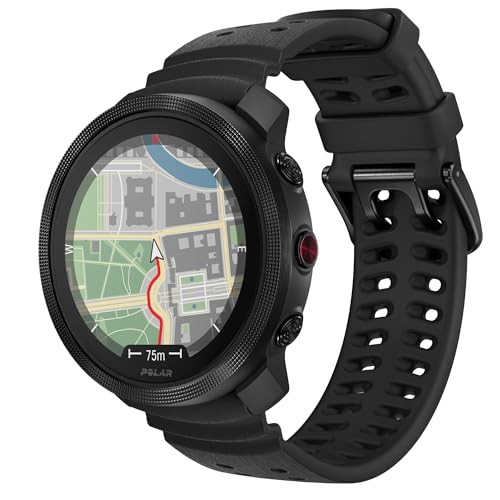
Best for recovery-led training and maps — Polar Vantage M3
Polar Flow training and recovery tools with offline topographic maps; phone music controls only.
On this page
- Garmin, COROS and Polar compared
- Three running watches in detail
- Which features change the decision?
- GPS, heart rate and battery: what the specs mean
- Which running-watch ecosystem fits you?
- The bottom line
- Frequently Asked Questions
Garmin, COROS and Polar compared
| Watch | Best fit | Navigation and music | Main limitation |
|---|---|---|---|
| Garmin Forerunner 265 | Broad training and everyday features | Follow a course; download music from supported services | No downloadable topographic maps on this model |
| COROS PACE 4 | Lightweight, run-focused use | Offline maps; local MP3 playback (no streaming apps) | No music-streaming apps on the watch |
| Polar Vantage M3 | Recovery-led training and mapped routes | Offline topographic maps; phone music controls (no onboard playback) | No onboard music playback |
All three have AMOLED screens and multi-band satellite positioning. That common ground does not establish that one records a more accurate route or heart rate for every runner. The differences above are features you can choose before buying.
Three running watches in detail
Garmin Forerunner 265 (46 mm, black) — A broad mix of run coaching and everyday tools
Garmin describes the 46 mm Forerunner 265 with multi-band GPS, daily suggested workouts, race-planning tools, Garmin Pay and music downloads from supported services. It is the easiest recommendation here for a runner who wants training features and phone-free playlists in one watch. Its course navigation can guide a saved route, but it does not provide the downloadable topographic mapping of the other two picks.
Best for: Adaptive run guidance, multi-band GPS and music downloads from supported services.
Watch out for: Its feature breadth can be more than a runner needs. If detailed maps are essential, compare a different Garmin model rather than assuming every Forerunner has them.
COROS PACE 4 (black, nylon strap) — A light watch with maps, not streaming apps
COROS specifies a 32 g weight with the nylon strap, an AMOLED screen and maps on the PACE 4. You can load MP3 files for phone-free listening, but COROS says its watches do not run music-streaming services. It suits a runner who wants a light, map-capable watch and is happy to manage local music files or run without audio.
Best for: A light nylon-strap design, offline maps and local MP3 playback.
Watch out for: This is the black nylon-strap variant. Check the strap and case size that suit your wrist; a different bundle may not feel the same.
Polar Vantage M3 — Training and recovery first, with offline maps
Polar’s Vantage M3 manual describes dual-frequency positioning, offline topographic maps and its training, sleep and recovery tools. That combination is compelling if you already use Polar Flow or want its approach to planning sessions. Its music feature is a remote for media playing on a paired phone, not phone-free playback.
Best for: Polar Flow training and recovery tools with offline topographic maps; phone music controls only.
Watch out for: Do not choose it expecting streaming or stored music on the watch. Check whether Polar Flow’s training views fit the way you review your runs.
Which features change the decision?
Routes are not the same as maps
The Forerunner 265 can follow a course line and show turn prompts, but lacks downloadable topographic maps. The PACE 4 and Vantage M3 can display offline maps. A mapped route is useful when you need visual context at junctions; a course line may be enough for familiar road runs. Check what the specific watch can display, rather than treating “navigation” as a single feature. Our GPS-watch buying guide covers the wider checklist.
Phone-free music needs the right format
Forerunner 265 supports downloaded music from compatible services, subject to the service and subscription. PACE 4 plays MP3 files copied to the watch but not streaming-service downloads. Vantage M3 controls music on your phone. If leaving the phone behind matters, this distinction is more useful than a general “music” tick in a specification table.
Training advice depends on the app you will use
Garmin Connect, COROS and Polar Flow organise workouts, load and recovery differently. Look at the screens you will actually use after a run. A watch that collects more metrics is not automatically more helpful. Our guide to VO₂ max and training-load features explains the common terms.

GPS, heart rate and battery: what the specs mean
Multi-band GPS is a feature, not a race result
All three selected watches offer multi-band or dual-frequency positioning. Buildings, tree cover, satellite conditions and settings still affect a recorded route. A specification sheet alone cannot establish a brand-wide accuracy winner. See our GPS accuracy explainer for what can distort distance.
Wrist heart rate has limits
Optical heart-rate readings can vary with fit, movement and the activity. If heart-rate zones guide your training, wear the watch as instructed and consider a compatible chest strap when you need a more dependable signal for intervals. Wrist heart-rate readings are not a medical measurement.
Compare battery in the mode you will run
A headline “days of use” figure is not comparable with continuous GPS recording. Multi-band positioning, always-on display, maps and music can shorten runtime. Garmin, COROS and Polar publish their figures under different settings; check the mode that matches your longest planned session. The PACE 4’s manufacturer-stated GPS endurance is a reason to consider it, not proof it will outlast every Garmin or Polar watch in every setup. Our watch battery-life guide explains the main settings that change runtime.

Which running-watch ecosystem fits you?
Choose Garmin if you want varied run planning, supported music-service downloads and broader everyday functions in the Forerunner 265. Choose COROS if a light watch, offline maps and simple run-focused use are the priority, and you can live with MP3 transfer instead of streaming apps. Choose Polar if Polar Flow’s training and recovery presentation suits you and phone-based music is enough.
If you are moving from another brand, check which of your historical activities and training plans you can import or recreate. Changing watches can be easy; changing the app you rely on every week can be the harder decision. If you do not need maps or advanced training tools, our simpler running-watch shortlist may be a better place to start.
The bottom line
The Garmin Forerunner 265 is our most versatile pick among these three for runners who want structured training and supported phone-free music. The COROS PACE 4 is the lighter map-capable alternative for runners comfortable with local MP3s or no music. The Polar Vantage M3 earns its place for Polar Flow training, recovery insights and offline maps. Choose by the features and app you will use, not by a blanket claim that one brand has the best GPS, battery or heart-rate sensor.
Frequently Asked Questions
Which is better for running, Garmin, COROS or Polar? No brand is best for every runner. In this comparison the Garmin Forerunner 265 has the broadest mix of training and everyday features, the COROS PACE 4 is a light watch with maps, and the Polar Vantage M3 emphasises training and recovery in Polar Flow.
Do all three watches have offline maps? No. The COROS PACE 4 and Polar Vantage M3 both support downloadable offline topographic maps. The Garmin Forerunner 265 can follow saved courses, but it is not a downloadable topographic-map watch.
Can I run without my phone and still listen to music? The Garmin Forerunner 265 can play supported downloaded music and the COROS PACE 4 can play MP3 files transferred to the watch. The Polar Vantage M3 controls music playing on a paired phone rather than storing music for playback.
Is COROS PACE 4 battery life always longer? No. Battery estimates depend on GPS mode, maps, music, display settings and other use. Compare the manufacturers’ figures for the settings you expect to use; they are not a controlled head-to-head test.
Is wrist heart rate accurate enough for intervals? Wrist optical readings can be affected by fit and movement. They may be useful for general trends, but a compatible chest strap can provide a steadier signal when precise interval-zone work matters.
Should I choose by the watch or the app? Both matter. Check the watch features you need during a run, then look at how Garmin Connect, the COROS app or Polar Flow presents workouts and recovery. You will use the app long after the first setup.