Flat feet do not automatically mean you need a stability shoe. The useful question is whether your gait, comfort and injury history respond well to added guidance, then whether the shoe fits your heel, midfoot, forefoot and usual running distance.
There is no defensible universal winner among the best running shoes for flat feet UK options. The ASICS GEL-KAYANO 32 is the cushioned stability choice, Brooks Adrenaline GTS 25 uses GuideRails for a familiar daily ride, Saucony Guide 18 relies on broad-platform geometry, and the women’s HOKA Arahi 8 is the lighter-feeling option.
In This Article
- Our direct answer
- The best stability running shoes at a glance
- Our recommendations
- How to choose
- Which should you buy?
- Frequently asked questions
Our Direct Answer
Start with the support sensation you already tolerate. ASICS offers the plushest ride here; Brooks uses GuideRails rather than a traditional medial post; Saucony builds guidance through a broad base and CenterPath geometry; HOKA uses a dual-density H-Frame in a lighter package.
The checked routes are UK-marketplace offers rather than imported Amazon US stock. They still open on a specific size or colour, so use the retailer’s selector to confirm your size and width and do not assume another variant has the same seller, price or return terms.
The Best Stability Running Shoes at a Glance
Compare the support mechanism and fit route, not a generic “flat feet” label. Each shoe guides the foot differently, and every linked retailer offer may default to one size or colour.
| Running shoe | Role | Support approach | Checked offer | Main limitation |
|---|---|---|---|---|
| ASICS GEL-KAYANO 32 | Cushioned stability | 4D Guidance System | UK-local seller; current family offer | Premium, substantial ride |
| Brooks Adrenaline GTS 25 Men’s | Guided daily trainer | GuideRails | Men’s UK 9.5; sold by Amazon | One size/colour route |
| Saucony Guide 18 Men’s | Broad-platform stability | CenterPath geometry | Men’s UK 9; Alton Sports | Low stock |
| HOKA Arahi 8 Women’s | Lighter women’s option | H-Frame | Women’s UK 6; sold by Amazon | Low stock and rocker feel |
The buttons may open a particular size or colour within a wider product family. Confirm the selected UK size, width, dispatch origin and return option before paying, and try shoes indoors on a clean surface while the return window remains usable.
Our Recommendations
1. ASICS GEL-KAYANO 32 — Best Cushioned Stability Option
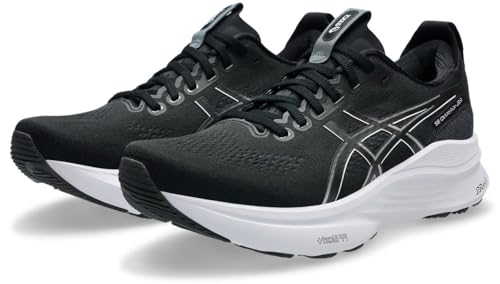
ASICS GEL-KAYANO 32 is a premium cushioned stability trainer. ASICS positions the GEL-KAYANO family for long-distance stability and overpronation. The 32 combines its adaptive 4D Guidance System with PureGEL and FF BLAST PLUS ECO cushioning, producing the most substantial and protective-feeling specification in this group.
That depth and softness will not suit everyone. It is the premium-priced choice, and flat arches alone do not prove that its level of guidance is right for your stride.
- Buy it if: you want plush cushioning with adaptive stability for regular road mileage.
- Skip it if: you prefer a lower, firmer or more flexible ride.
- Current availability: In stock from Amazon.
2. Brooks Adrenaline GTS 25 Men’s — Best GuideRails Daily Option

Brooks Adrenaline GTS 25 Men’s is a structured men’s daily trainer. Brooks combines GuideRails support with nitrogen-infused DNA LOFT v3 cushioning. The official UK range covers narrow through extra-wide men’s fittings, while the linked local offer is the green men’s UK 9.5 version.
GuideRails can feel less intrusive than an old-style post, but it is still a guided shoe. The linked offer is one size and colour, so switch variants carefully and recheck the seller and returns.
- Buy it if: you want a familiar supportive shoe for daily running and walking and UK 9.5 fits.
- Skip it if: you need a different size without first confirming the replacement offer.
- Current availability: In stock from Amazon.
3. Saucony Guide 18 Men’s — Best Broad-Platform Option

Saucony Guide 18 Men’s is a men’s stability shoe built around geometry. Its broad base and CenterPath asymmetric geometry aim to keep the foot centred from landing to toe-off without a hard medial post. PWRRUN foam and an engineered mesh upper make it a credible steady daily trainer. The linked black version is men’s UK 9.
Only three were shown in stock when checked. A broad base can feel secure but not necessarily nimble, and another Saucony size may have a different seller or price.
- Buy it if: you want smooth geometric guidance and the exact UK 9 offer fits.
- Skip it if: you need plentiful stock, a women’s fit or a narrower platform.
- Current availability: Only 3 left in stock from altonsports- Run and Fitness Store.
4. HOKA Arahi 8 Women’s — Best Lighter Women’s Option

HOKA Arahi 8 Women’s is a women’s guided road shoe with a lighter feel. HOKA’s dual-density H-Frame is designed to guide excess inward movement while retaining a streamlined ride. The model also uses a jacquard mesh upper, MetaRocker geometry and an 8mm drop. The checked UK-local offer is women’s UK 6.
Only two were shown in stock. The rocker and geometry feel distinctive, and neither the high sidewalls nor H-Frame guarantee comfort for your arch, orthotic or gait.
- Buy it if: you want a women’s stability option that feels less bulky than a traditional motion-control shoe.
- Skip it if: you dislike rocker geometry or need a different size without checking the alternate seller.
- Current availability: Only 2 left in stock from Amazon.
How to Choose Stability Running Shoes
Flat feet are not the same as overpronation
Low arches describe foot shape; overpronation describes movement. Some runners with flat feet run comfortably in neutral shoes, while others benefit from guidance. A stability shoe is not a treatment and should not be prescribed from a wet-footprint test alone.
Fit before support features
Leave about a thumb’s width beyond the longest toe, check that the upper does not squeeze the forefoot, and secure the heel without overtightening the laces. If you use orthoses, take them to a specialist shop and confirm the shoe has enough depth and a removable insole.
When to get gait or clinical advice
A specialist running shop can compare your stride in more than one shoe. If pain is persistent, worsening, associated with swelling or affects normal walking, seek appropriate medical or podiatry advice rather than trying progressively more supportive shoes.
Buying size-specific marketplace offers
A retailer button can land on one size or colour even when the wider shoe family is sold in men’s, women’s and different-width versions. Change the selector deliberately, then verify that seller, dispatch origin, price and returns still suit you.
Related reading: how to choose running shoes, carbon-plate running shoes.
Which Should You Buy?
Choose the ride, fit and support method that agrees with your running rather than treating flat arches as a diagnosis. ASICS suits runners wanting plush adaptive stability, Brooks offers familiar GuideRails support, Saucony uses a broad geometric base and the women’s HOKA is the lighter-feeling alternative.
Each retailer button can still default to one size or colour. If you cannot find a suitable width or a clean indoor try-on and return route, buy from a specialist running shop instead.
Frequently Asked Questions
What is the best running shoe for flat feet? There is no universal winner. ASICS GEL-KAYANO 32 suits runners wanting plush stability, Brooks Adrenaline GTS 25 offers GuideRails support, Saucony Guide 18 uses broad-platform geometry and the women’s HOKA Arahi 8 is lighter-feeling.
Do all runners with flat feet need stability shoes? No. Flat arches describe foot shape, while overpronation describes movement. Some runners with flat feet are comfortable in neutral shoes.
Can running shoes cure flat feet or pain? No. Shoes may change comfort or guidance for some runners, but they do not diagnose or cure a condition. Seek professional advice for persistent or severe pain.
How much toe room should running shoes have? Guy’s and St Thomas’ NHS guidance recommends roughly a thumb’s width beyond the longest toe, with enough width that the foot is not constricted.
Why does a retailer link open one size or colour? Retailer links can open a particular size or colour within a wider shoe family. Use the size and width selectors, then recheck the seller, dispatch origin, price and return option for the variant you choose.