The Salomon Active Skin 4 Set is the best balanced running vest here for most supported long runs and shorter trail races. Its four-litre storage, two included 500ml flasks and adjustable close fit cover the essentials without the bulk of an ultra pack. Runners carrying mandatory waterproofs and extra layers should start with the eight-litre INOV8 RacePac 8 instead.
Capacity is only half the decision. A vest must stay stable when its flasks and pockets are full, place food and a phone where you can reach them, and match the kit list for your actual race. This guide compares six current buying routes from budget and women-specific fits to lightweight five-litre and twelve-litre ultra options.
Running Vest Guide Sections
- Our direct answer
- Comparison table
- Six recommendations
- Choosing capacity
- Fit and sizing
- Hydration and pocket access
- Mandatory kit and race rules
- Final verdict
- Frequently asked questions
Best Running Vests: Our Direct Answer
Choose the Salomon Active Skin 4 Set for a first serious vest, supported trail races and long road runs where four litres and one litre of included front-flask capacity are enough. Choose the INOV8 RacePac 8 when your event kit list or British weather demands more room, and move to the Salomon Active Skin 12 Set for ultras and longer unsupported outings.
The Montane Gecko VP 5+ is the lightweight, close-fitting alternative for compact race loads. The Salomon Active Skin 4 Women adds a women-specific harness pattern, while the AONIJIE 5L is the lower-cost way to try a vest, with less precise sizing and only one included 500ml flask.
Product links can open a particular size and colour. Use the model recommendation as the starting point, then confirm the selected variant and measure against the manufacturer’s current size chart before ordering.
Running Vests Compared
Compare capacity against the load you normally carry. The hydration column states what the selected package says it includes; compatibility with an additional reservoir does not mean one is supplied.
| Running vest | Our award | Capacity | Hydration supplied | Best for |
|---|---|---|---|---|
| Salomon Active Skin 4 Set | Best balanced all-round vest | 4L | 2 × 500ml soft flasks | Short trails, long road runs and first race vests |
| INOV8 RacePac 8 | Best for mandatory race kit | 8L | Not clearly itemised — confirm before purchase | Longer trail races and changeable UK conditions |
| Salomon Active Skin 12 Set | Best for ultras and higher kit loads | 12L | 2 × 500ml soft flasks | Ultras, long unsupported runs and bulky layers |
| Montane Gecko VP 5+ | Best lightweight close-fitting option | 5L | 2 × 500ml soft flasks | Fast trail running with a compact load |
| Salomon Active Skin 4 Women | Best women-specific option | 4L | 2 × 500ml soft flasks | Runners preferring Salomon’s women-specific pattern |
| AONIJIE 5L Hydration Vest | Best budget starter vest | 5L | 1 × 500ml soft flask | Occasional runs and trying a vest for less |

The Six Best Running Vests Reviewed
1. Salomon Active Skin 4 Set — Best balanced all-round vest

The Salomon Active Skin 4 Set is the balanced choice for runners who need water, a phone, nutrition and a light layer without carrying an ultra-sized pack. Its four-litre capacity is suited to shorter trail events and supported long runs, while the two included 500ml soft flasks keep fluid accessible at the chest.
Salomon’s SensiFit construction and adjustable front cords are intended to hold the load close while allowing movement. Storage is spread across the front and rear rather than concentrated in one zipped compartment, so frequently used food and gloves can stay within reach. It is also compatible with a 1.5-litre reservoir and Salomon’s separate pole quiver.
The linked offer opens the black/metal medium variant. Measure against Salomon’s current size chart and check the selected size before ordering. Four litres can be restrictive when a race requires full waterproofs, spare insulation and extra food, in which case the eight- or twelve-litre options below give more margin.
2. INOV8 RacePac 8 — Best for mandatory race kit

The INOV8 RacePac 8 occupies the useful middle ground between a minimal race vest and a bulky ultra pack. Its stated eight-litre combined capacity is easier to organise for mandatory kit, food and changing weather than a four- or five-litre vest, without moving straight to twelve litres.
The front pockets are arranged for on-the-move access, and INOV8 describes the design as available in three sizes to control movement. That sizing choice is important: an eight-litre vest is only a strong race option when the loaded pack stays stable through descents and when reaching across the body.
This link opens the black small variant sold by Start Fitness through Amazon. The product page describes the package as two items but does not clearly itemise the hydration accessories in the title, so confirm the exact included flasks or reservoir before purchase. Treat eight litres as capacity, not proof that every event’s kit list will fit.
3. Salomon Active Skin 12 Set — Best for ultras and higher kit loads

The Salomon Active Skin 12 Set is the higher-capacity choice for ultras, winter trail days and runs where you must carry several layers. It includes two 500ml soft flasks and can also take a 1.5-litre reservoir, allowing runners to separate accessible drinking capacity from rear storage.
Compression straps help manage the larger rear compartment as the load changes. That matters because spare space is useful only when the contents are secured; a lightly packed twelve-litre vest can move more than a smaller model if it is not adjusted properly. The extra volume also makes clothing and mandatory equipment easier to separate from food.
The linked offer is the black/metal large variant. Twelve litres is unnecessary for supported half-marathons or short summer trails, and the extra fabric can feel warmer. Buy it because your typical kit list needs the room, not because a larger number automatically makes a better vest.
4. Montane Gecko VP 5+ — Best lightweight close-fitting option
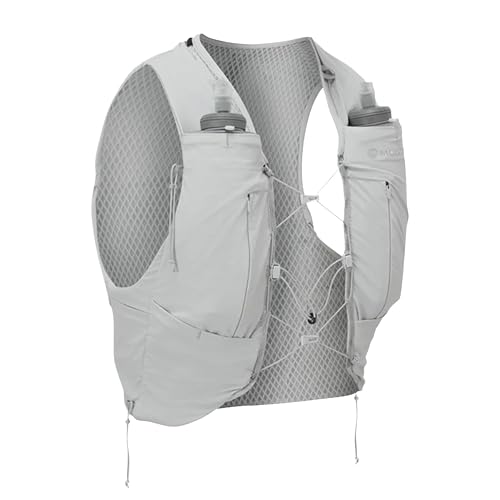
The Montane Gecko VP 5+ is the compact premium option for runners who value a close, stretch-led fit. The selected model is listed at 202g and includes two 500ml soft flasks, giving it a strong specification for fast trail sessions and races where five litres covers the required load.
Montane uses a four-way-stretch fabric and a one-step harness adjustment to balance tension across the torso. Multiple front pockets reduce the need to remove the vest for food or a phone, while a zipped rear pocket and safety whistle cover two practical race-day details.
The linked product is a white medium sold by Blacks and was showing limited stock when checked. White fabric will show trail dirt quickly, and a close stretch fit is less forgiving of poor sizing than a looser pack. Confirm both size and stock before relying on it for an event.
5. Salomon Active Skin 4 Women — Best women-specific option

The Salomon Active Skin 4 Women uses a women-specific version of the brand’s four-litre platform. It retains the two front 500ml flasks, secure storage and quiver compatibility of the unisex model, but gives buyers another torso and harness pattern to compare rather than assuming one unisex shape fits everyone.
A gender-labelled model is not automatically the correct fit. Chest position, torso length and preferred flask height differ between individuals, so test the loaded vest with the clothing you will race in. The right choice is the pattern that stays stable without pressure or restricted breathing.
The linked product opens the black medium variant and was showing limited stock when checked. Other sizes may be grouped on the product page, but availability can differ. Choose it for its pattern and pocket position; the unisex Active Skin 4 remains equally valid when it fits better.
6. AONIJIE 5L Hydration Vest — Best budget starter vest

The AONIJIE 5L is the budget route into a hydration vest. The selected one-size black package includes one 500ml soft flask and provides several external pockets, making it suitable for runners who want to discover whether chest-mounted hydration and vest storage suit them before spending more.
Its adjustable chest and waist straps offer more range than a fixed-size garment, but “one size” is also its biggest compromise. It cannot provide the same precise size choice as the INOV8, Salomon or Montane options, and the included fluid capacity is lower than the pairs supplied with most premium picks.
Use it for occasional training and lighter loads, after checking that the vest does not bounce or rub when full. Runners entering long mandatory-kit races should favour a sized model with enough confirmed storage and practise packing it well before race day.
How to Choose Running Vest Capacity
Begin with your bulkiest normal kit list, not an arbitrary race distance. A supported summer half-marathon may require little more than fluid, gels, a phone and a key, while a shorter fell race can demand full waterproofs, hat, gloves, food, map and emergency items.
- 4–5 litres: compact loads, supported long runs and races with limited mandatory kit.
- 8 litres: a useful middle ground for waterproofs, food and variable conditions.
- 12 litres: ultras, winter layers and longer unsupported routes where packing flexibility matters.
Do a test pack before deciding. Put the actual jacket, food, phone, first-aid items and full flasks into the vest. If the zip only closes with careful compression, move up a size in capacity. If the rear compartment remains mostly empty and the load shifts, a smaller vest may be easier to stabilise.
Running Vest Fit and Sizing
A running vest should wrap the torso rather than hang from the shoulders. Start with the maker’s chest measurement, then account for the layers worn on race day. The front should adjust without the panels overlapping excessively or the cords reaching their limit.
Perform a loaded bounce test
Fill the flasks, add your normal kit and jog, reach, twist and climb stairs. Look for upward movement, flask pressure against the ribs, cords that interfere with breathing and seams that rub the neck or underarm. Tightening every cord is not a cure for the wrong size.
Women-specific versus unisex fit
Women-specific models can change strap shaping, flask position and torso proportions, but body shape varies more than a label can capture. Compare both patterns where possible. The better fit is the one that holds a full load securely without compressing the chest or limiting arm movement.
Flasks, Reservoirs and Pocket Access
Front soft flasks make it easy to monitor remaining fluid and refill at an aid station. They also balance weight across the chest. A rear reservoir carries more in one container but is harder to inspect and refill, and its hose routing must stay secure.
Check what the exact package includes. Several vests accept a reservoir without supplying one, and some marketplace variants omit flasks. The selected Salomon and Montane sets state that two 500ml flasks are included; the budget AONIJIE package lists one.
Arrange pockets by frequency of use. Put food, gloves and navigation items where they can be reached without removing the vest. Keep keys in a secure zipped pocket, protect electronics from sweat and flask leaks, and avoid overfilling stretch pockets until items can work loose.

Mandatory Kit and Race Rules
The organiser’s current kit list overrides any generic capacity advice. Waterproof standards, spare layers, maps, cups, head torches and minimum fluid requirements differ by event and can change with the forecast. Check the latest organiser update alongside the Met Office seasonal advice; a vest that works for one race is not automatically compliant for another.
Pack mandatory items so officials can inspect them and so emergency equipment remains usable after rain. Most running vests are not waterproof compartments; use suitable dry bags or waterproof pouches where necessary. Do not rely on a product’s reflective trim as your only visibility measure.
Hydration needs also vary with weather, effort, aid-station spacing and the runner. Review our guides to choosing nutrition and hydration, running safely in hot weather and running energy gels when planning longer events.
Care and Maintenance
Empty every pocket after a run, rinse soft flasks promptly and let the vest dry fully before storage. Salt and drink residue collect around stretch pockets, cords and valves. Follow the care label rather than assuming a technical vest can be machine washed or tumble dried.
Inspect flask seams, bite valves, front cords and pocket stitching before a race. Replace leaking hydration components and repair small faults before loading the vest. Practise cleaning and repacking it after training so nothing important remains hidden in a pocket on race morning.
Which Running Vest Should You Buy?
The Salomon Active Skin 4 Set is the strongest starting point for a runner who wants a compact, well-equipped vest for ordinary long runs and shorter trail races. It supplies two front flasks and enough space for the essentials without encouraging an oversized load.
Choose the INOV8 RacePac 8 when mandatory kit is the deciding factor, or the Salomon Active Skin 12 when ultras and winter layers need more room. Montane’s Gecko VP 5+ prioritises a light, close fit; the women’s Active Skin 4 offers another harness pattern; and the AONIJIE makes sense only when low cost matters more than precise sizing.
Whichever model you choose, confirm the exact size and included hydration accessories, then complete several loaded training runs before using it in a race.
Frequently Asked Questions
What is the best running vest for most UK runners? The Salomon Active Skin 4 Set is the best balanced option here for supported long runs and shorter trail races. Choose a larger vest if your normal mandatory-kit load does not fit comfortably.
What size running vest do I need? Use the manufacturer’s current chest or torso chart, then test the vest with full flasks, food and the layers you will wear. It should stay stable without restricting breathing or arm movement.
Is a 5L running vest big enough for a marathon? It can be for a supported road marathon or a trail event with a short kit list. Race rules, weather and aid-station spacing matter more than distance alone, so test-pack the required equipment.
When should I choose an 8L or 12L running vest? Choose about eight litres for a substantial mandatory-kit list and variable conditions. Twelve litres suits ultras, winter layers and longer unsupported outings where you need more packing flexibility.
Are soft flasks included with every running vest? No. Some packages include two flasks, some include one and others supply none. Check the exact selected variant rather than assuming that reservoir or flask compatibility means hydration is included.
Do women need a women-specific running vest? Not necessarily. A women-specific pattern can change strap shape and flask position, but the best option is whichever women-specific or unisex model fits securely without pressure or rubbing.